AEO explained: how it differs from SEO and where to start
A user used to type a query, get ten blue links, and choose for themselves. Now they ask ChatGPT — and get one finished answer with a couple of names inside it. If your name isn't there, the click goes elsewhere, and it doesn't matter that you rank first in classic search. That's the gap AEO closes.
In short. AEO (Answer Engine Optimization) is optimization for AI answers. The goal isn't "rank higher" — it's "be inside the answer." It doesn't replace SEO; it builds on top of it. Some of the work overlaps, but success is measured by share of mentions, not by position.
What AEO is
AEO stands for Answer Engine Optimization — optimization for "answer engines." An answer engine is any system that returns a composed answer instead of a list of links: ChatGPT, Perplexity, Gemini, and the AI modes of Google and other search engines. AEO's job is to make sure your brand, product, or source page shows up in that answer.
A neighboring term is GEO (Generative Engine Optimization). The difference is subtle and barely matters in practice: GEO is about generative search broadly, AEO about landing in a specific answer. You can treat them as synonyms and skip the terminology debate.
How AEO differs from SEO
The main confusion: "AEO is the new SEO." It isn't. They're different goals with partly shared means.
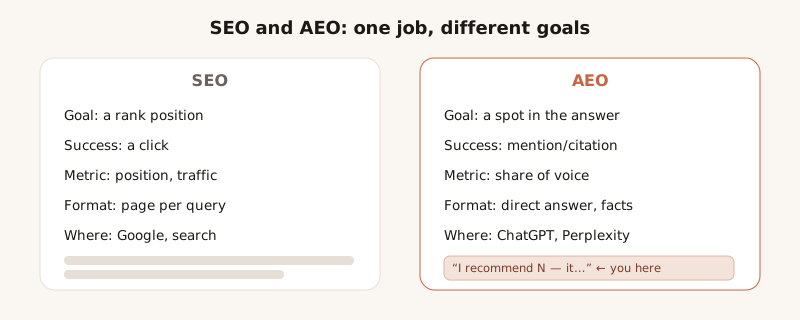
| SEO | AEO | |
|---|---|---|
| Unit of success | page position | brand mention in the answer |
| What you optimize | a page for a keyword | the brand entity across the web |
| Metric | traffic, rankings, CTR | share of voice, sentiment, citations |
| Content format | article for a query | direct answers, comparisons, numbers |
| Horizon | weeks–months | months (memory) + weeks (retrieval) |
What they share (don't throw away SEO)
Good news: you may already be doing half the work for AEO. When answering with search, models lean on the same signals as classic search: authoritative external mentions, clear page structure, speed, markup, domain reputation. A site that ranks well and is trusted has a head start in answers too. So AEO isn't "tear down SEO and start over" — it's "add another floor."
What's new in AEO
The goal is to land in the answer, not the top
You can sit tenth in the rankings and still be the only one ChatGPT names. And vice versa. Position and mention are different things.
Content is written for the question, not the keyword
The model wants a paragraph that answers directly: a comparison, a criteria list, a table, a number. "Keyword-density" copy doesn't work here — copy that's easy to quote does.
The brand as an entity
SEO is often about individual pages. AEO is about how the whole web "understands" your brand: is it one name everywhere, are the facts consistent, are you in Wikidata and directories.
A different metric
Positions aren't the point. The point is how often you're named in answers on target topics, with what sentiment, and who gets named instead of you.
Where to start: five steps
- Open your site to AI bots. Check
robots.txtforGPTBot,PerplexityBot,ClaudeBot, and make sure bots see text, not an empty page. This is the foundation — without it nothing else counts. - Collect 15–20 real customer questions in the wording people use with models ("which X tool to choose," "X or Y"). That's your AEO core.
- Give each question a direct answer on the site: a comparison, a table, an FAQ, numbers. Not an "about us" landing, but a paragraph ready to be quoted.
- Make the entity consistent. One name and one set of facts everywhere,
Organizationmarkup withsameAs, ideally a Wikidata entry. - Set up measurement. Without it you can't tell growth from noise.
More on the mechanics: how to get cited in AI answers. If you're not named at all yet — 7 reasons why. Term definitions are in the glossary.
How to tell AEO is working
In SEO you watch positions. In AEO there are no positions — there's share of mentions. So you measure results like this: take a set of target questions, run them regularly across ChatGPT, Claude, Gemini, and others, and see in how many answers the brand appears, what sentiment those mentions carry, and who stands next to you. That's what AI visibility monitoring does — it turns a vague "we're recommended more now" into a chart that shows the payoff of every step above.
FAQ
Is AEO a replacement for SEO?
No. AEO doesn't cancel SEO; it builds on it. Some factors overlap (external mentions, structure, authority), but the goal is different: not a search position, but a place in the answer itself.
How is AEO different from GEO?
They're close terms. GEO (Generative Engine Optimization) emphasizes generative search as a whole; AEO (Answer Engine Optimization) emphasizes landing in a specific answer. In practice they're used as synonyms.
How do you measure AEO results?
Not by positions, but by share of brand mentions in AI answers on target queries, the sentiment of those mentions, and whether your pages get cited. That's measured by regular monitoring across several models.