Why AI doesn't mention your brand: 7 reasons
You ask ChatGPT to "recommend a tool in our category" — and it names three competitors, but not you. Frustrating, but it's neither a verdict nor a conspiracy. It's a diagnosis, and it has seven typical causes. Let's go through each — and how to check whether it's your case.
First, separate the problem from the panic. The model didn't "decide to ignore you." It builds an answer from what it read in training and what it found in search just now (if you're curious how exactly — that's a separate breakdown). If you're not in the answer, then you're absent — or nearly absent — from one of those two sources. Here are the seven concrete "whys."
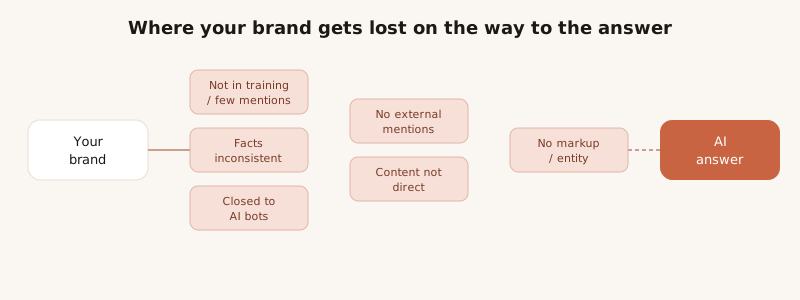
1. The brand wasn't in the training data
A young or niche brand simply wasn't around: at training time little or nothing was written about you. This is the most common cause for companies under two years old. It's slow to fix — mentions need to accumulate before the next training cycle — but live retrieval works in parallel and sees fresh material too.
How to check: ask the model with no internet access (offline mode) — "what do you know about brand N." An empty or generic answer means you're not in its memory.
2. Few mentions, or they contradict each other
You exist online, but as three different objects: "Acme," "Acme Services," and "acme.pro" with different descriptions. The model isn't sure it's one brand, so to be safe it names no one. Inconsistency is more dangerous than silence.
How to check: search your brand and compare the name, category, and key facts across the first 10 results. Discrepancies are your work for the month ahead.
3. The site is closed to AI bots
A basic, painful, fast-to-fix cause. If robots.txt blocks GPTBot, PerplexityBot, ClaudeBot, live retrieval has nothing to take from you. Many blocked these bots "just in case" a couple of years ago and forgot.
How to check: open yoursite/robots.txt and look for those user agents. If there's a Disallow: /, remove it — if you want to appear in answers.
4. The crawler sees an empty page
A React or Vue site that serves the bot an empty shell and paints in the content with a script? A crawler without JS reads an empty <div id="root"> and leaves. There's no text to cite, even though to a human the page looks complete.
Our own site had this: half the pages went to crawlers empty. We build a product about AI visibility — and were invisible to AI. Check this first.
How to check: open the page as "view source" (not dev tools). If the main text isn't there, it's painted by a script and the bot won't see it.
5. No external footprint
All content about the brand lives only on your own site. To a model that's a weak signal — everyone praises themselves. What carries weight is independent platforms: industry media, communities, aggregators, review sites, "best X tools" roundups. Search cites those more readily than your own landing page.
How to check: ask Perplexity for "best tools in category X" and look at the sources under the answer. If it's roundups and reviews — and you're not in them — there's your task.
6. The content doesn't answer the question directly
You have pages, but they're about you, not about the customer's question. The model wants a paragraph it can quote as an answer: a comparison, a table, an FAQ, concrete numbers. "We're a team of professionals since 2015" can't be quoted.
How to check: take 5 real customer questions and find a paragraph on your site that directly answers each. If you can't, neither can the model.
7. No structured entity
Without Organization markup, a sameAs field, and a Wikidata entry, it's harder for models to tie scattered facts into one brand. This isn't ranking magic — it's a way to tell the machine in plain terms: here's who we are, here are our profiles, here's what we do.
How to check: run your homepage through the Schema.org validator. No Organization? Add it — a couple of hours of one-time work.
What to fix first
If there are several causes (and there usually are), the order is:
- Technical first — items 3 and 4. They close in a day; without them the rest is pointless.
- Then the entity — items 2 and 7. Consistency and markup have a long tail.
- Then footprint and content — items 5 and 6. Ongoing work, not a one-off.
- Item 1 is solved by time — but everything above speeds it up.
How to see instead of guess
The problem with all seven causes is that you can't track them by eye: one ChatGPT run proves nothing, and running dozens of queries across seven models by hand every week is impossible. So turn "we're not mentioned" from a feeling into a number — with regular visibility measurement: which queries, which models, mentioned or not, with what sentiment, and who got named instead of you. Then after each fix you can see which of the seven causes was the real one.
More: how to get cited in AI answers and AEO explained.
FAQ
Why does ChatGPT confidently recommend a competitor but doesn't know us at all?
The competitor has more consistent mentions in sources the model read and its search reads. It's not algorithmic bias — it's a difference in external footprint.
The model said something false about us — can that be fixed?
Yes, but not by complaining to the model. You need to remove the fact mismatch across the web: update stale pages, align data in directories and profiles, add structured markup. Live retrieval will start pulling the correct version first.
Where do I start if there are several causes at once?
Start with the technical blockers: AI-bot access and text visibility for the crawler. Both close in a day, and without them nothing else matters. Then brand consistency and external mentions.