How to get cited in AI answers: mechanics, not mantras
"Create quality content." That's how nine out of ten articles about ChatGPT visibility end. The advice isn't wrong. It's useless — it tells you nothing about what to do on Monday morning.
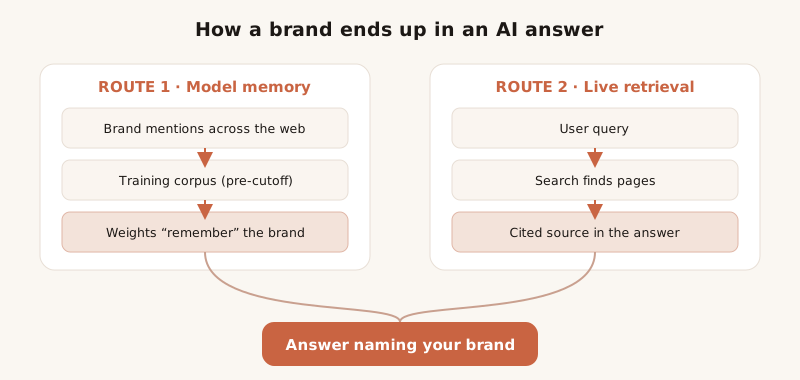
To know what to do, you have to know where a model actually gets a brand name from. And it comes from exactly two places.
In short. A brand shows up in an answer either because the model remembers it from training, or because its search pulled it in right now. The first depends on the volume and consistency of mentions across the web. The second depends on having fresh, citable pages. You don't control the prompt. You do control the sources.
Two routes into an answer
When you ask "which CRM would you recommend for a small business," the model assembles its answer from two sources at once.
Route one — the model's memory. During training it read a huge slice of the internet and compressed it into weights. If your brand appeared tens of thousands of times in that slice, the model "remembers" it and names it even with no internet. If it appeared twice, it won't.
Route two — live retrieval. ChatGPT with search, Perplexity, grounded Gemini don't rely on memory alone. They query a search index, grab a few pages, and answer from them. Here what wins isn't what was true a year ago — it's what's findable now.
What this looks like in real data
This isn't theory. Here's our run of the "business banks" category across different models. Tinkoff renamed to T-Bank back in 2024 — and the models split:
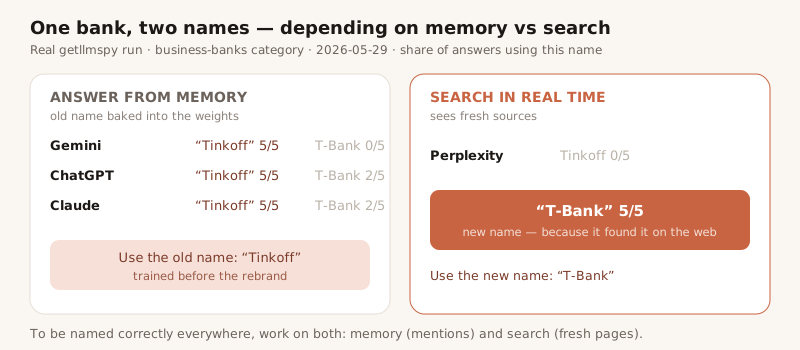
Gemini, ChatGPT, and Claude answer from memory — and in 5 answers out of 5 they use the old "Tinkoff." Perplexity uses search — and in 5 of 5 says the new "T-Bank." One bank, two names, decided purely by whether the model remembers or searches.
The practical takeaway: there's nothing to optimize except the sources. The user writes the prompt; you can't negotiate with the model. You can only make sure there's something to read about you — in training data and in live search.
What actually moves mentions
In descending order of payoff. Not "10 hacks" — the things that affect both routes at once.
1. Name consistency
To a model, a brand is an entity assembled from dozens of sources. "Acme LLC" on the site, "Acme Services" in directories, "acme.pro" on social — to the model that's three objects. Make the name and facts identical everywhere. Boring, and it beats half of all "content strategies."
2. Mentions on sources retrieval trusts
Retrievers cite authoritative pages, not random ones: industry media, reputable communities, aggregators, review sites, Wikipedia. One mention in a respected outlet outweighs ten pages on your own site — it's external confirmation.
📊 From the data. In our run of the business-CRM category, Bitrix24 and amoCRM get named in almost every answer (5/5 on most models). YCLIENTS almost never. The difference isn't the product — it's the external footprint: the leaders are written about everywhere, the rest barely anywhere.
3. Direct answers to questions
The model wants a paragraph that answers directly: comparisons ("X or Y"), tables, FAQs, numbers — easy to quote. A mission statement isn't.
4. Structured data
Organization markup with sameAs, a Wikidata entry, consistent directories — all of it helps the model tie facts to your entity. One-time technical work with a long tail.
5. Accessibility to AI bots
Half of all sites shoot themselves in the foot. robots.txt blocks GPTBot and PerplexityBot — nothing to cite. The site serves bots an empty JS shell — same result.
We caught this bug on our own site: half the pages served crawlers an empty shell. A product about AI visibility was invisible to AI. An expensive irony — check this first.
6. External footprint
Marketplace ratings, mentions in roundups, expert commentary — raw material for both routes at once: being "remembered" and being "found."
7. Freshness
Live retrieval loves new. Regular publishing gives the retriever a reason to come back. Write once and forget is a strategy for route one, not route two.
| Lever | Memory | Live retrieval |
|---|---|---|
| Name consistency | strong | medium |
| External mentions | strong | strong |
| Direct answers / FAQ | medium | strong |
| Schema + Wikidata | medium | strong |
| AI-bot access | — | critical |
| Freshness | weak | strong |
How to tell it worked
The main trap is checking by hand. You open ChatGPT, ask, see yourself, celebrate. Next day the answer differs, in another region differs, for a colleague differs. One run means nothing — answers are probabilistic.
📊 From the data. In that same CRM category, RetailCRM shows up in just 2 of 5 ChatGPT answers (40%) but 5 of 5 on Claude and Gemini. From a single run you'd conclude either "we're never named" or "always named" — depending which model you hit. The truth only shows on a repeatable sweep across all models.
So you need a repeatable measurement: one prompt set, across all models, on a schedule, recording share of mentions, sentiment, and who gets named instead of you. That's AI visibility monitoring.
What to do this week
- Check
robots.txtand confirm bots see text, not an empty page. - Make your brand name and facts identical everywhere.
- Add
Organizationmarkup withsameAs. - Write one comparison page around a real customer question.
- Set up a baseline measurement so you have something to compare against.
More: why AI doesn't mention your brand — 7 reasons, AEO explained, and the brand-splitting study on real data.
FAQ
Can I "optimize the prompt" so the model names my brand?
No. The user writes the prompt, not you. You can only influence the sources: what the model learned in training and what search pulls in at answer time.
Why does ChatGPT know my competitor but not us?
Usually the competitor has more consistent mentions across sources the model and its search trust. To a model a brand is an entity built from many external confirmations.
How long until results show?
Inclusion via live retrieval (Perplexity, ChatGPT Search) can appear within weeks of publishing a citable piece. Inclusion in the model's "memory" depends on the next training cycle and is measured in months.