Brand splitting: how AI fragments your name and steals share of voice
Tinkoff became T-Bank back in 2024. Yet ask an AI model "which bank should a sole proprietor pick," and half of them still answer "Tinkoff." We ran the category through getllmspy — 7 models, 600 answers — and watched a rebrand slice a brand's visibility into pieces. And it's not a one-off: the same thing happens to dozens of companies that have no idea.
In short. AI models split one brand into several "entities" — by old names, spelling variants, and sub-brands. Each shard looks mid-table; together they'd lead. In the "business banks" category, Tinkoff/T-Bank fragmented into four names; reassembled, it tops the list by a wide margin. The fix is name consistency — not content, not budget.
What we measured
We took the "banks for sole proprietors and the self-employed" category and ran a fixed set of organic queries (no brand names hinted) through seven models: ChatGPT, Claude, Gemini, Perplexity, Grok, DeepSeek, and YandexGPT. That's 600 answers, a snapshot from May 29, 2026. For each answer we recorded which brands were mentioned. Then we simply counted who gets named, and how often.
The headline finding: a rebrand splits the brand
Here's the leaderboard if you count each name separately, the way a model sees it:
| Brand (as the model named it) | Mentions |
|---|---|
| Sberbank | 26 |
| Alfa-Bank | 26 |
| Tinkoff Bank | 21 |
| Modulbank | 21 |
| VTB | 21 |
| Tochka | 20 |
| Tochka Bank | 14 |
| Tinkoff | 13 |
| T-Bank | 12 |
Tinkoff looks like it's third here — as "Tinkoff Bank" (21). But look closer: the same bank sits in the table three more times — "Tinkoff" (13), "T-Bank" (12), and "Tinkoff Business" (6). The models don't realize it's one company, so they smear it across four rows.
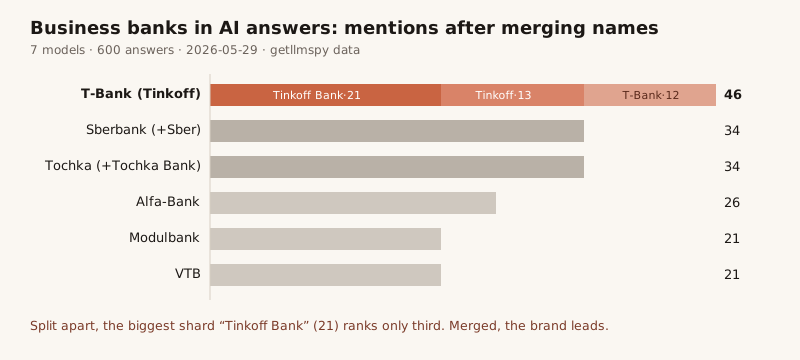
Merge them back, and the picture flips:
| After merging entities | Mentions |
|---|---|
| T-Bank (Tinkoff) | 46 |
| Sberbank (+ Sber) | 34 |
| Tochka (+ Tochka Bank) | 34 |
| Alfa-Bank | 26 |
| Modulbank | 21 |
The bank that drifted in third place is actually the clear category leader. The models just won't let it "assemble": every shard competes with itself. To a marketing team it looks like the brand is slipping in AI, when in fact it leads — the data is simply torn apart.
Why model memory says "Tinkoff" while search says "T-Bank"
The most interesting part is the per-model breakdown. We counted, for each model, how many answers use the old name "Tinkoff" versus the new "T-Bank":
| Model | "Tinkoff" | "T-Bank" |
|---|---|---|
| ChatGPT | 5 of 5 | 2 of 5 |
| Claude | 5 of 5 | 2 of 5 |
| Gemini | 5 of 5 | 0 of 5 |
| DeepSeek | 4 of 4 | 1 of 4 |
| Perplexity | 0 of 5 | 5 of 5 |
| Grok | 1 of 5 | 1 of 5 |
The pattern is exactly the one we described in the two routes a brand takes into an answer. Models that answer from memory (ChatGPT, Claude, Gemini, DeepSeek) are stuck on the old "Tinkoff" — it's baked into their weights from training. Perplexity, which uses live search, only says the new "T-Bank," because it sees fresh sources. Gemini is the most stubborn: it never said "T-Bank" once.
The takeaway for anyone who has changed their name: the old name lives on in AI models long after a rebrand. Until enough of the new name accumulates in training data, half the models will keep calling you by the old one — and splitting your visibility.
It's not just Tinkoff
We checked two more categories with the same method — the pattern repeats.
Business CRM. "Битрикс24" (26 mentions) and the Latin-script "Bitrix24" (13) are one product, split by spelling. Together: 39, clear first place. Apart, "Битрикс24" barely edges out RetailCRM (23) and amoCRM (21, plus 5 more for "AmoCRM").
SMB accounting. Here the split is at its worst. The models name "Kontur" as "Контур" (16), "Контур.Эльба" (14), "Контур.Бухгалтерия" (19), and plain "Эльба" (11) — four names for one ecosystem, 60 mentions combined. Meanwhile the category "leader" looks like "Moyo Delo" with 21. In reality Kontur dominates threefold — you just can't see it in the raw snapshot.
Why it happens
To a model, a brand isn't a registry line — it's an entity it assembles from thousands of sources. If you appear online under different names — old and new, Cyrillic and Latin, with and without sub-brands — the model isn't sure it's one object and creates several. From there each "entity" collects mentions on its own. The more your name varies across the web, the deeper the split.
What to do about it
- Make the name identical everywhere — site, directories, social, review sites, registries. One primary spelling, one line of business.
- After a rebrand, build a bridge. On authoritative pages, tie the old and new name explicitly: "T-Bank (formerly Tinkoff)." Models and their search pick up these links.
- Tie the entity together with markup.
OrganizationwithsameAs, a Wikidata entry, consistent directory data — a direct signal to the machine that "this is all us." - Measure across every name variant, not one. Otherwise you undercount your real visibility and mistake a split for a failure.
More on the mechanics: how to get cited in AI answers, and if you're not named at all — 7 reasons why.
How this was measured
In the open, so the numbers are trustworthy. Category: "banks for sole proprietors and the self-employed," 7 models (one current version per vendor, routed through an aggregator), a fixed set of organic queries with no brand names, 600 answers, snapshot of May 29, 2026, collected via getllmspy. A "mention" is the fact of a brand being named in an answer (regardless of length or position). The per-model sample is small, so per-model shares are directional, not precise to the percentage point; the overall split pattern is robust and visible across all three categories. Entity merging was done by hand on obvious matches (old/new name, spelling, sub-brands).
FAQ
Where does the data come from?
From real getllmspy runs: a fixed set of queries is run across several models, and brand mentions are tagged in the answers. It's not a survey or expert opinion — it's what the models actually answered on May 29, 2026.
Why does an AI call a company by its old name after a rebrand?
Because the old name is baked into the model's weights at training, while the new one hasn't accumulated in sources yet. Memory-based models lag; models with live search switch faster. The gap is visible right in the data: Perplexity already says "T-Bank," Gemini still says only "Tinkoff."
How do I tell whether my brand is split in AI answers?
Run your target queries across several models and count mentions across all variants of your name at once. If the sum is meaningfully larger than your biggest single variant, you're split — and your real visibility is higher than it looks.